
| FOR IMMEDIATE RELEASE Contact: Jeff Naft Jeff.Naft@mail.house.gov Date: September 17, 2020 |
| At Congressional Oversight Commission Hearing, Hill Showcases Arkansas | |
|
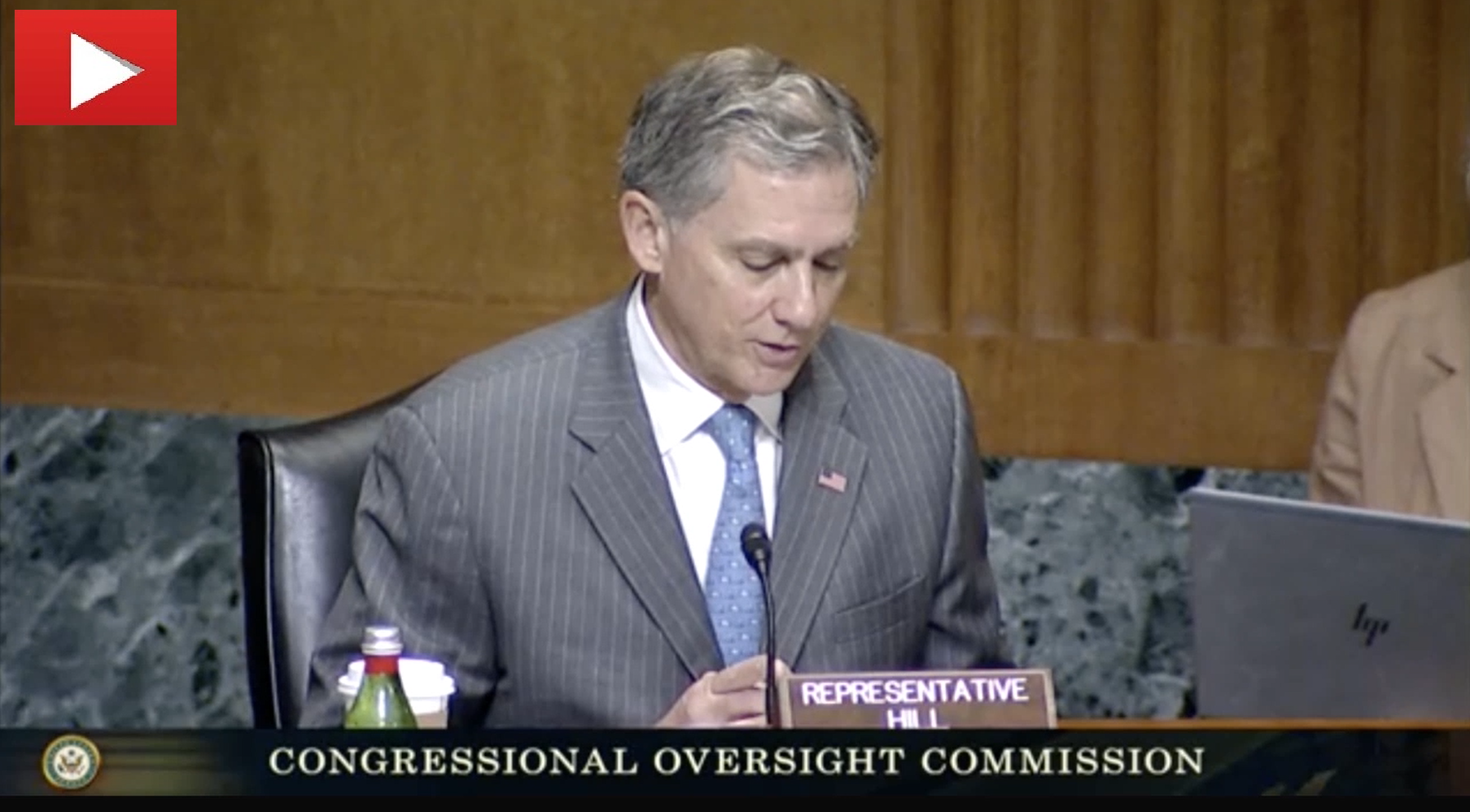
WASHINGTON D.C. — Today, Rep. French Hill (AR-02) participated in the Congressional Oversight Commission's second hearing entitled, "Examining the Municipal Liquidity Facility." The Commission heard from two panels of witnesses on the use of the Municipal Liquidity Facility (MLF) established by the CARES Act which benefits state and local governments impacted by the COVID-19 pandemic. Rep. Hill’s opening remarks highlighted how Arkansas is safely navigating the pandemic while still promoting economic activity and stability. He also inquired about ways organizations like the Arkansas Development Finance Authority, the exclusive issuer of bonds for Arkansas, and other state agencies, might be able to participate in the MLF. To watch the key excerpts, click HERE or on the image below.
Rep. Hill's opening statement as delivered included below: Thank you, Madame Chair, and thank you to the witnesses for providing your expertise today. Today we are discussing the Municipal Liquidity Facility. This continues to be a heated topic on Capitol Hill as state and local municipalities determine how best to balance their budgets and fight COVID-19. Last week, in the House Financial Services Committee, we held a hearing precisely on this issue. This challenge varies widely across the nation. Rep. Hill: "I do want to talk about another challenge to smaller states and that’s the use of entities to issue debt to participate in the MLF and then support lower subdivisions in their state. Is it the Fed’s intention to let these sorts of conduit issuers have access to the program?" Hiteshew: "It may be able to. And also, of course, the state or Little Rock for example, could borrow on behalf of one of these arenas or entities pursuant to the downstreaming provisions of the original MLF design." Background on the Congressional Oversight Commission and Today's Hearing: The Congressional Oversight Commission is a five-person panel that was established by the CARES Act. The Commission is focused specifically on the economic stabilization efforts of the Treasury Department and the Federal Reserve. The members of the commission are Senator Pat Toomey (R-Pa.), Congresswoman Donna Shalala (D-Fla.), Congressman French Hill (R-Ark.), and Bharat Ramamurti. The Commission's chairperson has not been appointed yet. The Commission has released three reports, all of which are available for review at the Congressional Oversight Commission’s website. During the hearing, the Congressional Oversight Commission heard from two panels.
Archived video is available via the Congressional Oversight Commission’s website. Witness testimony is available on the website. |
|
|
### To learn more about Congressman French Hill, please visit: Hill.House.Gov |


|