| FOR IMMEDIATE RELEASE Contact: Jeff Naft Jeff.Naft@mail.house.gov Date: February 4, 2021 |
| Hill Leads Hearing Outlining Resources Available to Small Businesses | |
|
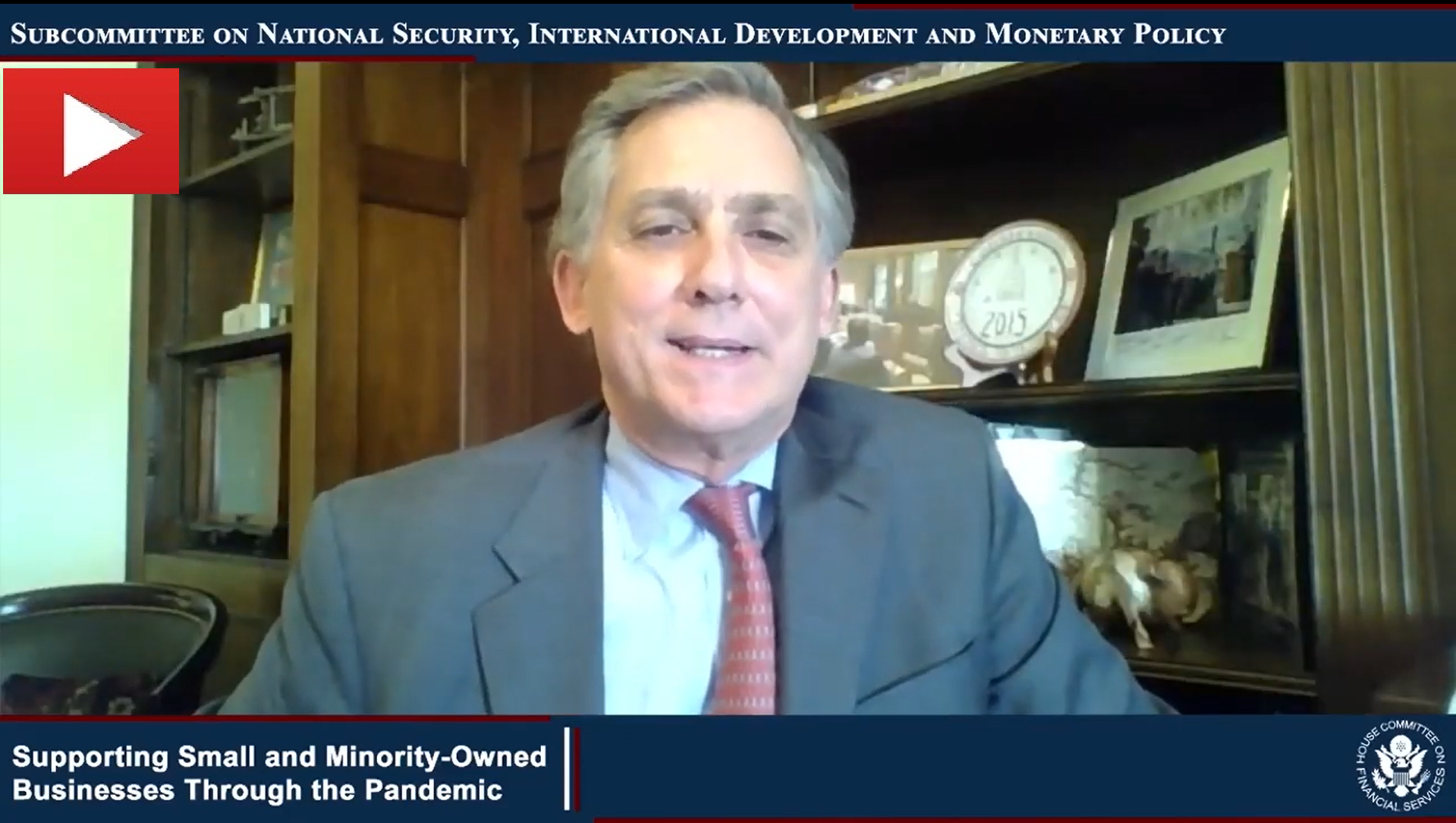
WASHINGTON, D.C. — Ranking Member of the House Financial Services Subcommittee on National Security, International Development and Monetary Policy, Rep. French Hill (AR-02), helped lead the virtual hearing entitled, “Supporting Small and Minority-Owned Businesses Through the Pandemic.” The subcommittee examined the changing financial concerns of small businesses and considered policies that build on such programs, like the State Small Business Credit Initiative, that could provide additional relief during this public health and economic crisis. Watch Rep. Hill’s opening remarks and questions from the hearing HERE or by clicking on the image below.
Rep. Hill's opening statement: I thank my friend from Connecticut, and I want to say what a treat it is to refer to Jim Himes as Chairman of this subcommittee. Not that those of us on the Republican side of the aisle don’t want the word “Chairman” as a prefix to our names, but we look forward to working with you, and we appreciate the attitude you have and the critical support you’ve delivered as a member of the Intelligence Committee and a longtime supporter of America’s national security. This task force, as Rep. Stephen Lynch will certainly report, that was turned into a subcommittee, happened the year that Reps. Emmer and Zeldin, and I came into the House. And all six years have been very impressed with the original Terrorism Task Force that’s now the National Security Subcommittee, on, as you pointed out, the bipartisan nature of the committee. And I want to thank the Republicans in the last Congress for being creative and collaborative with their Democratic colleagues. And we got a number of good bills out of this committee and the full committee and across the House floor that countered China’s debt trap, lack of transparency, and their creditor status in the Third World, something that’s very important to a lot of members on both sides of the aisle to shine a light on that as well as holding them accountable in a number of ways. So I thank all my colleagues on both sides of the aisle for their work on this subcommittee. I also would say that Mr. Himes and I share this interest in International Affairs, and we know that this committee is a major partner in America’s strategy, both in sanctions and identifying ways to cut off terror finance, collaboration with transnational crime, around the world. And that issue has not gone away even though the committee in the last Congress was more focused on the international finance arena and in China’s emerging rival status with the United States. So again, let me echo what you said, which is encourage members on both sides of the aisle to visit with me on the best ideas you have for both hearings and legislative priorities. Today we are discussing the State Small Business Credit Initiative, which would reintroduce a program that was created back in 2010 after the financial crisis. It’s aimed at providing additional funding to assist small businesses. It seems to me that this is a similar hearing to the one this Subcommittee held last summer on H.R. 6918, the Paycheck Recovery Act, that would require the U.S. Treasury to provide grants to small businesses. As I mentioned last summer, and it bears repeating now, these types of programs, in my view, should not be moving through this subcommittee. Instead, the House Small Business Committee should be analyzing the state of all aspects of financing for small businesses, including the State Small Business Credit Initiative. As a long-time supporter of small business and as someone who has previously spent a part of four decades starting businesses, I am not denying the importance of ensuring that small businesses remain operational. I am simply stating our subcommittee could be better suited to discuss the issues squarely in our jurisdiction, such as items just mentioned by Chairman Himes and myself, threats from China, the annual oversight of CFIUS, which we’re supposed to do, and even in the last Congress we never accomplished it, and obviously the importance of monetary policy oversight, just to name a few. Instead, we are using our limited hearing time to discuss this program. As of today, the federal government has authorized nearly $3.8 trillion in COVID-19 relief. Of that, about a trillion dollars is aimed at small business relief. Specifically, the Paycheck Protection Program, the largest federal small business program, with over $650 billion that has been allocated and $100 billion of which still remains, including for first-time users and second-chance PPP users. I was reviewing the State Small Business Credit program that was set up during the Obama administration. It was about $1.5 billion, and not all of the funds ended up being allocated over the years of the program. It had very limited oversight and didn’t seem to achieve its proposed goals from looking at the General Accountability Office’s summary of this program. In my home state of Arkansas, I contacted the Arkansas Development Finance Authority, which oversaw this program. I spoke with the individuals that were responsible for implementing it and was told, and I quote, “it was not a pleasant experience,” and as far as they noted to me, it did not save or create a single job during the term of them attempting to use it in my home state. As many of us know, the success of the PPP program from last year’s CARES Act had kinks and faults as any start-up program with the government has. Something that was created and immediately in two weeks began sending grant loans to small businesses. However, over the last 10 months, many of those flaws have been corrected, and businesses are receiving the benefits of the Paycheck Protection Program. So, another thing I’m very cautious about today as we start this hearing is trying to initiate another program with a start-up phase that would be subject to many rulemakings and frequently asked questions that would potentially complicate things and delay our small businesses’ further access to funds, particularly when we have so much at the state now that we’ve advanced in the EIDL loans and the Paycheck Protection loans. Two big, well-funded, successful programs as a part of the CARES Act and are in the jurisdiction of the Small Business Committee. And with that, Mr. Chairman, I yield back, and I look forward to the discussion today. Rep. Hill praises Community Development Financial Institutions in Arkansas: Thanks, Mr. Chairman, and what an excellent panel. I know the members are excited to listen to these informed, knowledgeable panelists. And of course, you're talking about very good specifics on how to improve our small business lending programs, like the PPP, EIDL, the 7A program, and those are all under the jurisdiction of the House Small Business Committee, and not this committee. But I think the discussion has been very informative. I represent the fourth largest depository CDFI in the country, Southern Bancorp in central Arkansas, and they do such a great job. I was on the CDFI advisory board during the end of Bush 43 and the beginning of the Obama administration, so I've seen the good work of CDFIs and the CDFI loan funds around the country. And I know how engaged you've been, and that's why Congress in both the CARES Act and the subsequent bills, has increased the set-asides that were being discussed. Mr. Sands talked about and Mr. Cunningham, $30 billion in PPP for CDFIs and minority banks, and then in the December bill, $12 billion directly to the CDFI fund so that they can do direct investment in low-moderate income communities. And then a $15 billion set-aside if you want to use that term for minority banks and CDFIs in the third round of PPP. And when you look at the loans in those programs, they really are everything from $500 up to 87 percent of the loans or under $150,000. So it really was a remarkable program, and I appreciate Ms. Wade talking about how many of her members benefitted, and all of our members of Congress love doing business with and visiting with our NFIB members in our districts.
|
|
|
### To learn more about Congressman French Hill, please visit: Hill.House.Gov |


|