
| FOR IMMEDIATE RELEASE Contact: Jeff Naft Jeff.Naft@mail.house.gov Date: February 24, 2021 |
|
|
|
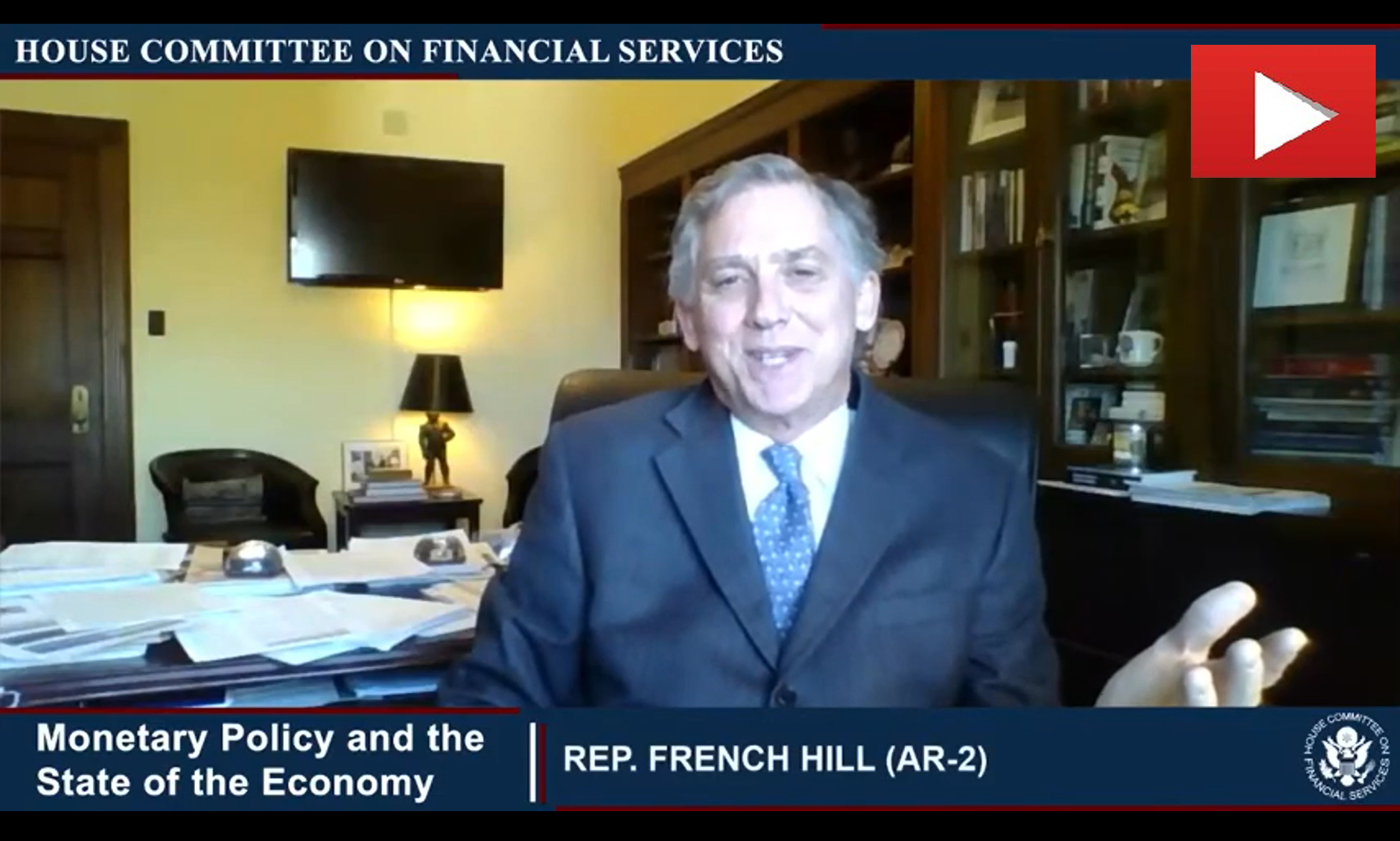
WASHINGTON D.C. — Today, during the Financial Services Committee Hearing titled "Monetary Policy and the State of the Economy", Rep. French Hill presented opening remarks and questioned witness, Chairman of the Federal Reserve, Jerome Powell.
Opening Statement: Thank you Madam Chair and I want to echo the comments from friends and Chairman, Chairman Himes of the subcommittee. We thank you chairman Powell for the extraordinary actions of the Board of Governors during 2020 in monetary policy, in extraordinary facilities in using 13 3, and we also commend the Congress and the Executive branch in 2020 for their fiscal response, which gave us the resources we needed to fight the pandemic and get our economy to the point it is today to open. So, I agree with chairman Himes that now it's time to look on the other side of this pandemic as we vaccinate America, as we get our businesses open, as we see state and local governments having far in excess of the tax revenues that they anticipated and people getting back to work. How do we safely open this economy, get those jobs available for those 10 million Americans still seeking employment, and I look forward to your testimony today. I yield back Madam Chair. Hill: Thank you Madam Chair. Chairman Powell It's great to see you. Thanks for your time on Capitol Hill this week and we do appreciate it as everyone has said your extraordinary leadership in the Board of Governors here. Since last March the Fed has purchased more than $1.8 trillion of U.S. Treasury securities and last week you reiterated as you did yesterday in the Senate that Fed remains patiently accommodated in its monetary policy position but this extraordinary amount of accommodation is now coupled with the decision that the Treasury has recently announced, Chair Yellen, that they're planning on drawing down their cash account they ordered, the Fed, by almost a trillion dollars which would inject that directly into the economy. My question Chairman Powell is, has Secretary Yellen discussed with you drawing down the Treasury account? Powell: As a matter of long practice, I don't discuss my private conversations with elected representatives or with the Treasury secretary but of course we're well aware, you know, there's a there's an ongoing staff level dialogue, you know, about between Treasury and the Fed and the New York fed about the Treasury general account and what the plans are for that so we're well aware of it. Hill: If a trillion dollars was drawn out of that account and injected do you think that could cause short-term interest rates, something you're very concerned about it at the board of governors in a very keen focus monetary policy, could that cause short term rates to go negative? Powell: So, it could play it could put downward pressure on short term rates of course our principal concern is that the federal funds rate be within the range that the FOMC has is ordered it to be and we have the tools to make sure that that's the case and if that is the case then it will be the case that will be within our range will be where we need to be. That's going to tend to work against the other, you know, short-term money market rates going too low. Hill: So, it's a key, key point that's why I'm concerned about that impact in the market understanding it. I mean for example I assume the Board of Governors monetary policy reaction to that if short term rates went negative is you could raise the rates on the IOER range that you have. Would that be a tool that you could take into effect? Powell: Yes, we haven’t made any decisions about this at all but of course that and also that the rate on the reverse repo facility are the two things that we can move and those are our two administered rates and so those would be the tools that we can use among others frankly but that's other things that we can do. Hill: Well certainly in light of what Anne Wagner asked about a few minutes ago on the supplemental leverage ratio these things kind of come together in the banking system and managing those expectations either the level short term rates or the dislocation in rates and the Fed’s reaction to it, or that kind of cash coming out into the banking system and thus aggravating that supplemental leverage ratio. These are important issues, and I would encourage the board to consider action sooner rather than later because of that March 31 date. Chairman Himes raised a really interesting question and Mr. Barr did as well about the indicators you look at when you're evaluating this inflation move. We mentioned raw commodity index like other members have mentioned that it's up 18% year over year, gold is up 15% year over year, but the one I always watch and the one we saw come into play in the run up to the last financial crisis, is residential real estate. As you know 24% of the CPI is an imputed rent that the Bureau of Labor statistics uses. I've never bought it. I don't know if you've ever bought it but it's up about 3% right now, but if you look at the prices of existing homes I think there are 12%. New home prices are up 8% is that one that you particularly focus on that imputed residential rents since it is about 25% of the CPI and how do you look at that issue? Powell: We do of course follow a broad range of prices, you know, it's half our mandate is price stability so we have a lot of attention paid to many different things. The most important thing really is inflation expectations. Are they anchored? And we have great tools for looking at them including a new common index of inflation expectations. You ask about real estate housing residential real estate prices and the very high levels of increases at the high levels of increases we saw this year there are a bunch of one time factors; there was a suppression of demand at the beginning of the increase in demand as the as the industry reopened, brakes are low, people are working at home all those things tend to raise rates will be lower for some time, but people won't be working at home forever and all those things tend to push up demand our best estimate is that we will see this increases but that would be much lower level. Thank you.
|
|
|
### To learn more about Congressman French Hill, please visit: Hill.House.Gov |


|